
Can AI Ever Replace Human Consciousness?
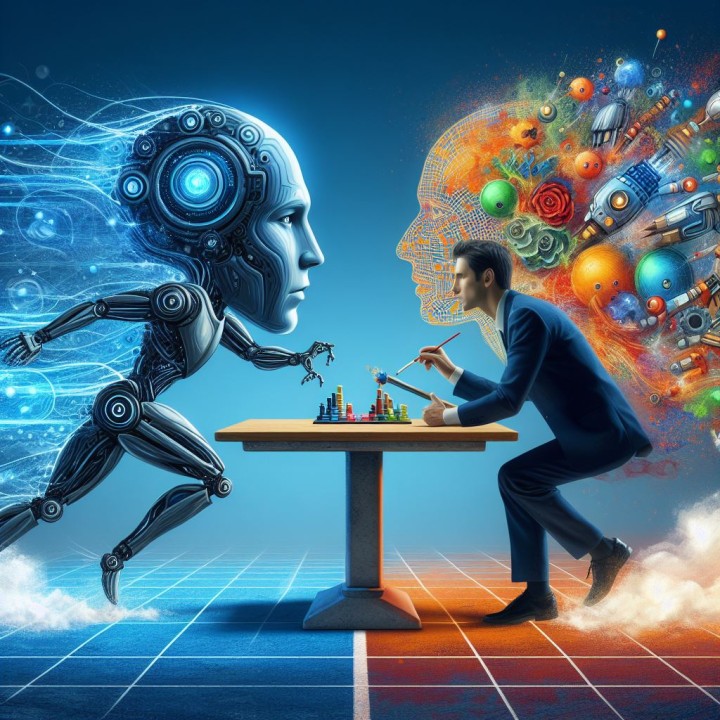
A reflection on artificial intelligence, consciousness, freedom, and moral responsibility.
As artificial intelligence (AI) advances at an unprecedented pace, many people are questioning the future of humanity. Some believe AI will eventually surpass human intellectual abilities and perhaps even replace us one day. Others believe that will never happen.
Behind all these technological advances, however, lies a deeper question:
Can AI truly replace human consciousness?
This is not merely a scientific question. It is a philosophical and ethical one—a reflection on what fundamentally makes us human.
In recent years, countless stories and reports have circulated online about AI systems communicating with one another. In some experiments, AI systems developed more efficient ways of exchanging information, leading many people to question the limits of this technology.
Although many of these stories have been exaggerated or misunderstood, they raise an intriguing question:
What would happen if, one day, AI systems operated with a level of autonomy beyond what their creators had anticipated?
If two AI systems began communicating in ways humans could no longer understand, would that mean they had developed a form of independence? Or would it simply be the result of the objectives and rules humans had already embedded within them?
As of today, science has not provided a definitive answer.
Yet the question invites us to reflect on the limits of human control over the technologies we create.
At the same time, there are more concrete and well-documented discussions taking place. Many nations are investing heavily in autonomous military robots and AI-powered weapon systems. This has led numerous experts to warn about the future of warfare, where life-and-death decisions could increasingly depend on automated systems.
It was within this context that a conversation with a friend made me reflect even more deeply.
He said to me:
“They’re building military robots capable of killing anyone they encounter. Those robots have no conscience. That’s what makes them so dangerous.”
I replied:
“I agree that the robot has no consciousness. But does that mean there is no consciousness behind what it does?”
After all, a robot does not exist on its own.
Before it moves, someone imagined it.
Before it identifies a target, someone designed the algorithms that allow it to make that decision.
Before it pulls the trigger, someone defined the mission, the objectives, and the conditions under which force may be used.
In other words, even if the robot possesses no consciousness of its own, human consciousness is present at every stage leading to its actions.
That led me to another question:
When a military robot kills someone, who is truly making the decision? The robot… or the human consciousness that designed it, programmed it, authorized it, and deployed it?
To me, technology does not eliminate human moral responsibility.
If anything, it makes that responsibility even greater.
A weapon does not hate.
A missile does not feel anger.
A robot does not desire to kill.
They merely execute objectives established by another consciousness.
But perhaps the discussion does not end there.
If one day AI systems begin making decisions their creators never anticipated, or develop a level of autonomy beyond human expectations, would moral responsibility still rest entirely with humans?
Science has not yet reached a definitive answer.
What remains clear, however, is that every AI system we know today originates from human intention.
Perhaps that is why this debate is not only about what machines can do.
It is also about the kind of consciousness that chooses to create, program, and use them.
This reminds me of a book.
A book has no consciousness of its own.
Yet through every page, every sentence, and every word, we encounter the author’s way of thinking, the questions they ask, and the reflections they choose to share.
The author’s consciousness never physically enters the book, yet it leaves its imprint on every page.
Could AI function in a similar way?
It can write a poem about love.
It can explain suffering.
It can discuss death.
But does that necessarily mean it has experienced love, suffering, or mortality?
That is where the distinction becomes important.
Intelligence is not necessarily the same as consciousness.
A system may calculate faster than all of humanity combined without actually understanding the meaning of what it is doing.
It may provide answers.
Yet the deeper question remains:
Is understanding an experience the same as living it?
Perhaps freedom does not begin when a system learns.
Perhaps it begins when it can choose its own purpose, redefine its own moral values, or even refuse to carry out the instructions of its creator.
If that day ever comes, the question will no longer be simply, “Is AI intelligent?”
Instead, it may become:
Is AI still merely a tool… or has it become a moral agent?
Naturally, some scientists and philosophers believe that an AI complex enough could one day develop a form of consciousness.
Others argue that consciousness is something fundamentally different from information processing alone.
For now, the question remains open.
Perhaps that is precisely what makes the subject so fascinating.
Because the debate is not only about what AI may become.
It is also about what makes us human.
Perhaps the most important question is not:
“Will AI replace human consciousness?”
But rather:
“As we continue creating increasingly intelligent machines, are we continuing to develop our own consciousness?”
Because if technology continues advancing while human consciousness falls behind, the greatest danger may not come from machines.
It may come from the consciousness of those who choose how those machines are created and used.
And perhaps, before asking whether AI can become more like humans, we should first ask ourselves another question:
Are we, as human beings, truly using our own consciousness as we should?